Inventory Replenishment: Methods and Best Practices
September 7, 2026

September 7, 2026

It sometimes takes very little to throw your inventory replenishment off balance. A product sells faster than expected. A supplier announces a few days of delay. A large sales order comes in just as inventory is running low.
On the other hand, ordering too early or in excessive quantities creates other problems. Boxes start piling up, available storage space shrinks, and part of your cash remains tied up in products waiting to be sold.
Inventory replenishment management is about finding the right balance. When should you reorder? How much should you order? How much inventory should you keep on hand? Different replenishment methods can help answer these questions depending on your products, suppliers, and sales patterns.
Inventory replenishment covers the activities required to make sure a business has the goods, raw materials, or components it needs to operate. It starts with identifying a need and continues through to receiving products into inventory.
For a business that buys and resells products, the goal is to keep enough inventory available to fulfill sales orders without filling the warehouse with items that may sit there for months.
For manufacturers, replenishment also concerns the raw materials and components required for production. Running out of a single component can delay the production of an entire finished product.
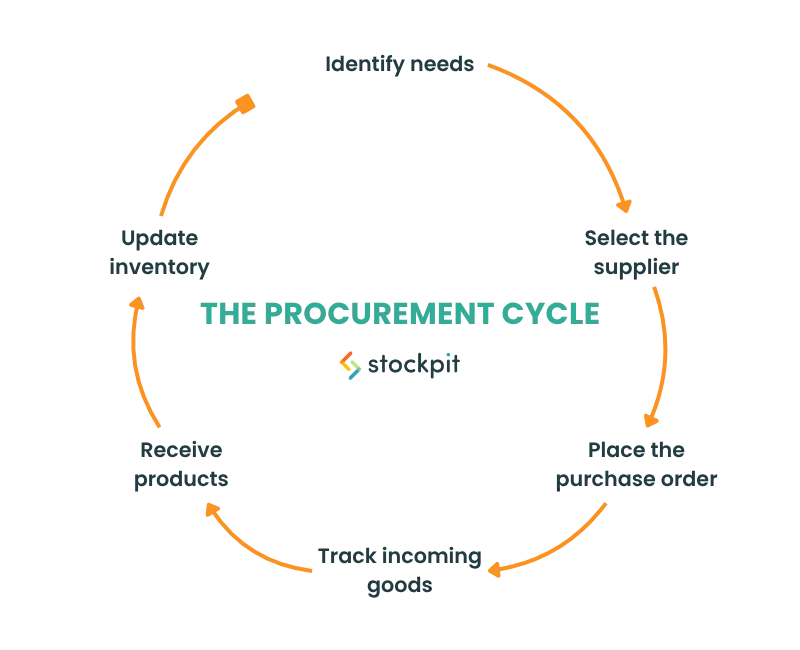
Although the process varies from one business to another, procurement generally follows several steps:
Each step affects the next. An incorrect available inventory quantity can trigger an unnecessary purchase order. An inaccurate supplier lead time can cause a stockout even when the purchase order appeared to be placed on time.
Orders delivered on time have a direct impact on customer satisfaction. This is especially true in B2B, where a delay can quickly affect your customers’ own operations.
Consistent delivery times also matter in a business relationship. Customers who know they can rely on you to meet promised timelines are more likely to feel confident placing repeat orders.
Effective inventory replenishment management helps you anticipate demand, meet promised delivery dates, and maintain a high service level even as demand changes.
The temptation is understandable: if you want to avoid stockouts, why not simply order more?
That extra security comes at a cost. Purchased goods tie up cash until they are sold. They also take up space and may generate additional storage and handling costs. Some products can also lose value, become obsolete, or reach their expiration date.
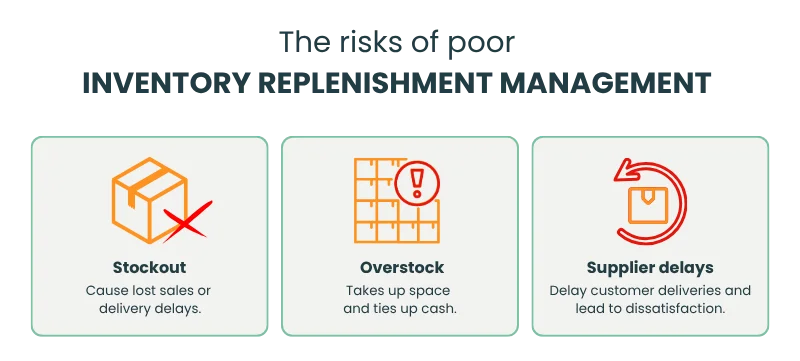
Stockouts are probably the most visible risk. Available inventory reaches zero while demand continues.
For an e-commerce business, the product becomes unavailable. For a B2B distributor, a sales order may be put on hold while waiting for a missing item. Stockouts can therefore lead to lost sales or delivery delays.
The situation is even more frustrating when a purchase order is already on its way. In that case, the issue often comes down to ordering too late or not monitoring inventory closely enough.
At the other end of the spectrum, a business may accumulate far more inventory than it actually sells.
Imagine a product ordered in cases of 200 units because it sold extremely well the previous year. A few months later, demand slows down. There are still 350 units sitting on the shelves, and another shipment has just arrived.
Those products take up space, while the money invested in them remains tied up. If the goods become obsolete or no longer find buyers, they can eventually have a direct impact on profitability.
Even accurate sales forecasts cannot protect you from a supplier running late.
Supplier lead times should therefore be built into your replenishment planning. Tracking actual delivery times and having backup options for your most sensitive products can help reduce dependency on individual suppliers.
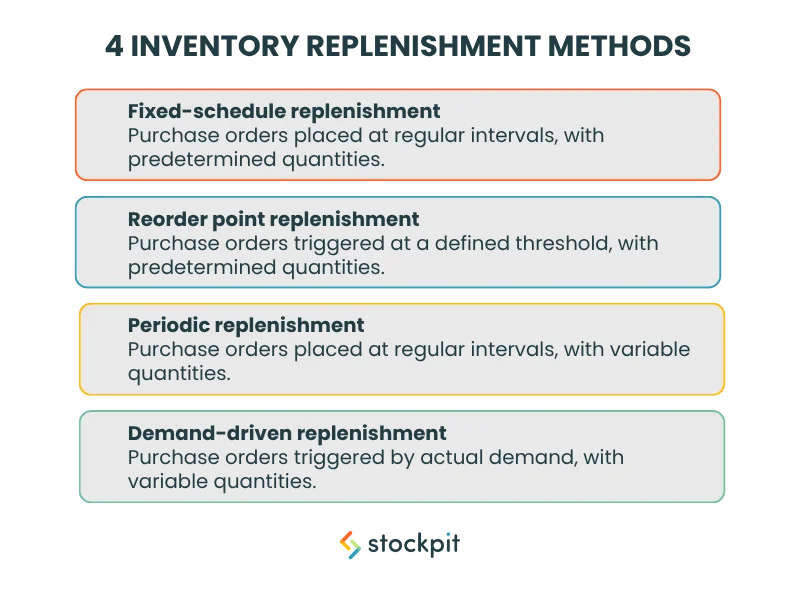
There is no single method that works for every product. The right approach depends on factors such as sales consistency, supplier constraints, available storage space, and product value. A business can also combine several replenishment methods.
With this method, replenishment orders are placed at regular intervals and for quantities defined in advance.
It works best for products with stable demand. Its main limitation appears when demand fluctuates significantly.
A purchase order is triggered when inventory falls below a predefined threshold.
This reorder point should leave enough inventory available to continue fulfilling sales orders during the supplier lead time.
With this method, the business reviews inventory at regular intervals and orders the quantity needed to return to a target inventory level.
If the target is 500 units and only 180 remain at the time of the review, the business places a purchase order for 320 units to bring inventory back to the target level.
The quantity ordered therefore varies based on consumption, while inventory reviews and ordering dates remain regular.
For products that are expensive, bulky, or sold less frequently, a business may choose to keep limited inventory on hand and purchase according to actual demand or forecasts using a just-in-time approach.
This reduces the amount of inventory being stored, but requires more accurate demand tracking and close monitoring of supplier lead times.
Looking only at remaining inventory gives you an incomplete picture.
Take two products with 30 units available. The first can be replenished in three days. The second takes four weeks to arrive. Even if they sell at the same rate, they should clearly not trigger a purchase order at the same time.
Agreements can also be established with suppliers to secure specific delivery lead times and make replenishment planning more predictable.
The reorder point, or replenishment threshold, defines the inventory level at which a new purchase order should be triggered for each item.
A commonly used formula takes into account average consumption during the supplier lead time, plus safety stock. For example, if a product sells 10 units per day and the supplier lead time is 7 days, you already need 70 units to cover that period. Add 20 units of safety stock, and the reorder point becomes 90 units.
This threshold should be reviewed whenever sales patterns or supplier lead times change.
Sales history helps you understand how each product behaves over time. It can reveal seasonality, rising demand, or, on the other hand, an item whose inventory turnover is slowing down. Historical data can then be used to adjust replenishment needs.
To manage replenishment effectively, you need to know what is actually available, understand how quickly products are moving, anticipate supplier lead times, and place purchase orders early enough to account for those lead times.
As the number of SKUs and inventory movements increases, this becomes harder to manage with spreadsheets or manual checks.
Stockpit lets you track inventory levels and movements in real time, set reorder points, and create and receive purchase orders. The software also supports multiple inventory locations, stock counts, and inventory valuation.
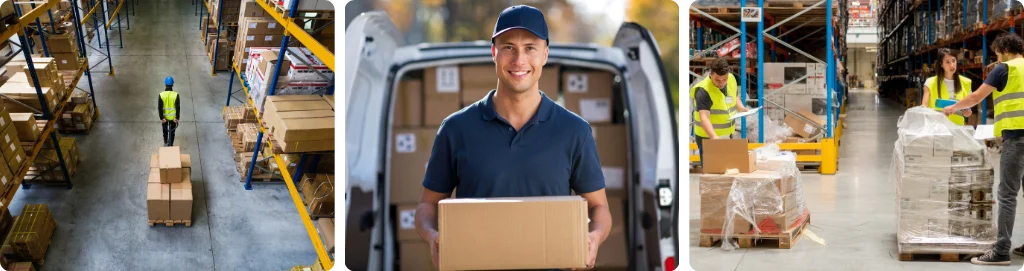
Teams get a shared view of inventory levels and incoming goods. An item approaching its reorder point can be identified before the shelf or warehouse location is empty.
Effective inventory replenishment management is not about holding as much inventory as possible. The goal is to maintain quantities that match your business activity, supplier lead times, and demand.
Inventory replenishment covers the activities that allow a business to maintain the products, goods, or components it needs to operate. This includes identifying requirements, placing purchase orders with suppliers, tracking lead times, and receiving goods into inventory.
The main methods include fixed-schedule replenishment, reorder point replenishment, periodic replenishment, and demand-based replenishment. A business can use several methods depending on product turnover, supplier lead times, and sales consistency.
The right time to order depends mainly on product consumption, available inventory, quantities already on order, and the supplier lead time. A reorder point can be set to indicate when a new purchase order should be placed.
To reduce stockouts, regularly monitor inventory levels, understand supplier lead times, and anticipate product consumption. Setting appropriate reorder points and safety stock also helps trigger purchase orders before inventory runs out.
Say goodbye to stockouts! Get your inventory valuation, monitor the inflow and outflow of products and keep track of your inventory.


