Consignment inventory: what you need to know before integrating it into your business
April 8, 2026

April 8, 2026

Buying inventory is often a gamble. A bet on demand, trends, and your ability to sell quickly. For many businesses, that gamble can quickly impact cash flow.
Between the risk of unsold goods and tied-up capital, traditional purchasing models sometimes show their limits. This is where consignment inventory, also known as consignment stock, offers an interesting alternative.
It allows you to offer products without paying for them upfront. But behind that promise, there are also operational challenges, especially when it comes to inventory management.
In this article, you’ll learn what consignment inventory is, how consignment stock works in practice, who it’s for, and how it impacts your operations.
Consignment inventory refers to goods placed at a retailer’s location but still owned by the supplier, known as the consignor, until they are sold. The retailer, or consignee, acts as a sales intermediary rather than a traditional buyer.
In a traditional model, the buyer pays for products upon receipt or within agreed payment terms. With consignment stock, payment only occurs after the product is sold to the end customer.
In practice, the consignor places products at a distributor, retailer, or point of sale. The consignee stores or displays the products and sells them to their customers. The products are only invoiced once they are sold.
In most consignment inventory agreements, the consignee earns a margin or commission on each sale, creating a shared incentive to sell the product.
Unsold items can be returned to the consignor, depending on the agreed terms. This reduces the reseller’s risk but requires accurate tracking of consignment inventory movements.
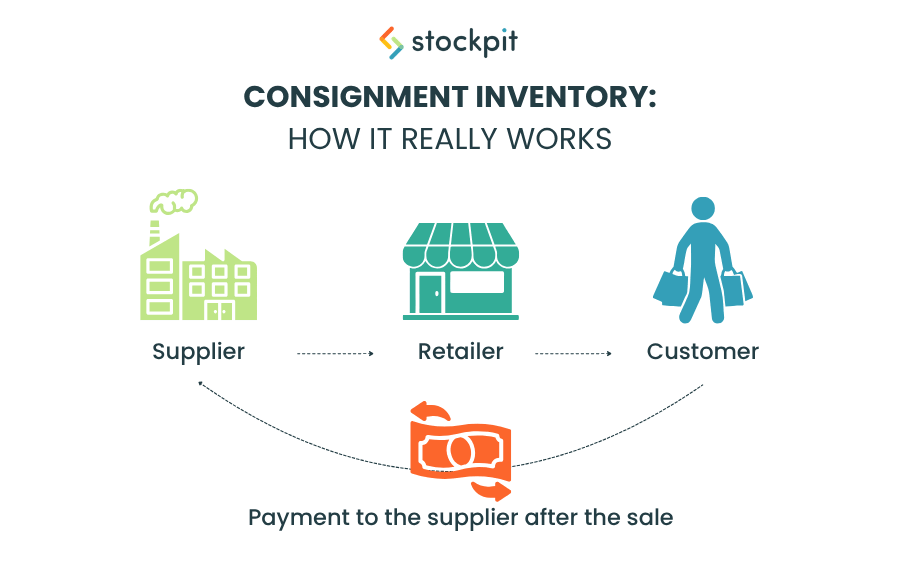
Let’s take a simple example.
A cosmetics brand (the consignor) places several products with a retailer (the consignee): a moisturizer, a vitamin C serum, and a facial cleanser. The retailer displays these products without paying for them upfront. When a customer purchases an item, the supplier issues an invoice and the retailer pays for the products sold.
If some items don’t sell, they can be returned after a defined period. This allows the consignee to avoid committing to products they’re not sure will sell, while the consignor increases product visibility.
Consignment inventory involves multiple stakeholders, each with different objectives.
The supplier (consignor) retains ownership of the consignment stock until it is sold. This represents a financial commitment, but also an opportunity.
By placing products with multiple resellers, suppliers increase visibility and sales potential. It’s often used to enter new markets or test new distribution channels.
For retailers (consignees), consignment inventory makes it possible to expand their product range without tying up cash.
They can test new products, diversify their assortment, and adapt more easily to demand. The risk of unsold inventory is significantly reduced, which is particularly valuable in industries with unpredictable demand.
Some industries rely more heavily on this model.
Retail, fashion, and specialized products are typical examples. Whenever demand is uncertain, seasonal, or trend-driven, consignment stock becomes a relevant option.
It is also used in B2B environments, especially for technical parts, bulky products, or consumables, where customers want inventory available without upfront costs.
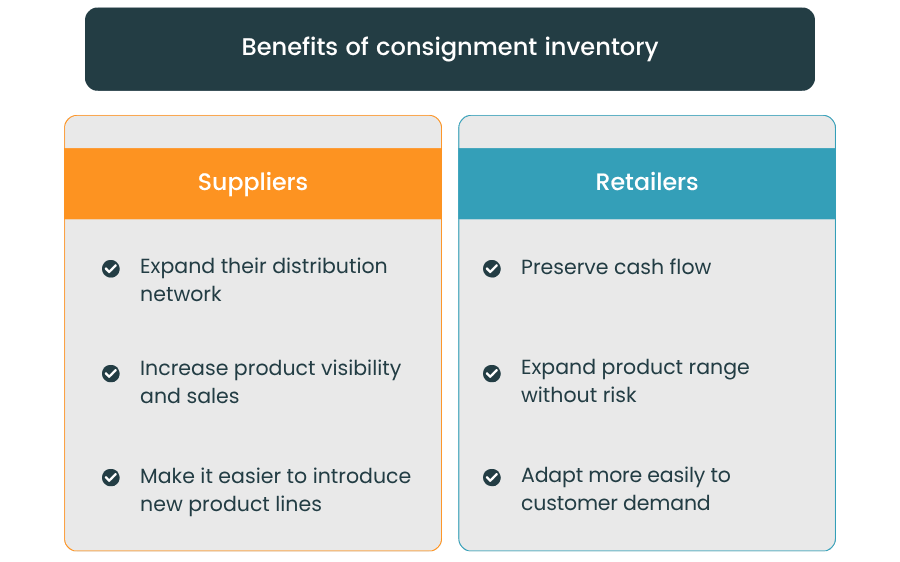
The main benefit of consignment inventory is risk management.
For retailers, it allows them to offer products without tying up capital. This improves financial flexibility and reduces losses from unsold inventory.
It also provides commercial flexibility. Testing new product lines, adjusting the assortment, and responding to demand becomes easier.
For suppliers, even though they retain ownership of the consignment stock, this model helps expand distribution networks and increase potential sales volume. It also facilitates entry into new markets.
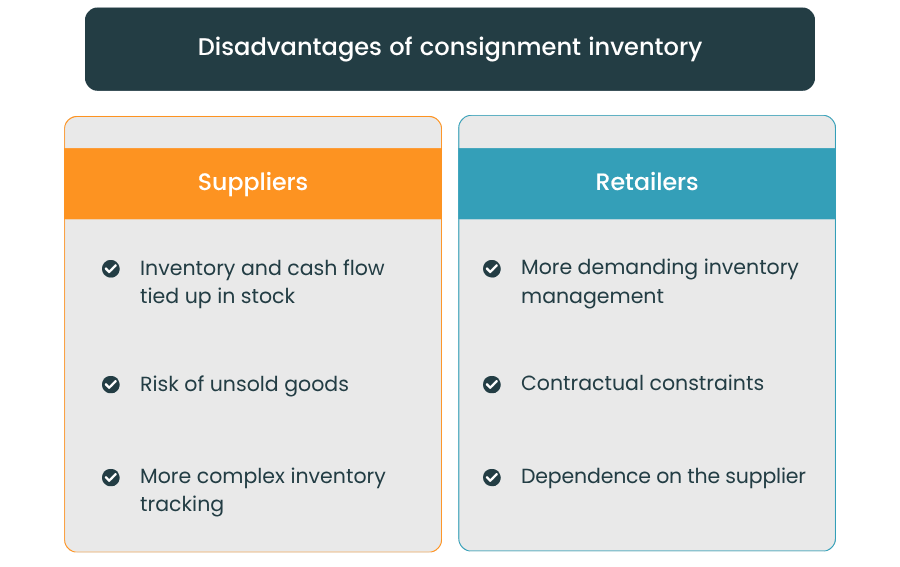
Consignment inventory also comes with constraints.
For suppliers, the main downside is inventory holding costs. Products are available at the reseller’s location but only generate revenue once sold. In addition, resellers may not prioritize these products if they need to push other items first.
There is also a risk related to unsold goods, especially if items are returned damaged or lose value over time.
For retailers, managing consignment stock can become more demanding. They need to track what has been sold, what remains in inventory, and what needs to be returned.
Finally, this model creates a level of dependency between both parties. Poor coordination can lead to errors, friction, or financial losses.$
This is often where challenges arise.
With consignment inventory, your products are distributed across multiple locations. It becomes essential to maintain a clear overview of consignment stock across all sites.
Without accurate tracking, errors can quickly occur. Incorrect inventory valuation, discrepancies in stock counts, or replenishment mistakes are common risks.
Inventory management also becomes more dynamic. Movements are no longer limited to standard operations but also include stock placements, returns, and adjustments.
On a daily basis, several challenges emerge.
You need to know what is available at each location, what has been sold, and where stock needs to be replenished.
Synchronizing sales data with inventory levels is critical. Any delay can lead to invoicing errors or unexpected stockouts.
Returns also require strict control. Every movement must be tracked to avoid discrepancies.
Managing consignment inventory in spreadsheets quickly reaches its limits.
Data becomes harder to maintain, errors increase, and visibility decreases. As your business grows, manual processes become a bottleneck.
An inventory management system allows you to centralize data, track movements in real time, and clearly distinguish between standard inventory and consignment stock.

Consignment inventory offers a valuable alternative to traditional purchasing models. It helps reduce risk, preserve cash flow, and increase flexibility.
But this model relies on one key factor: control.
Without clear visibility over consignment stock and movements, the benefits can quickly turn into constraints. Consignment requires precise tracking, strong coordination, and the right tools.
This is where Stockpit comes in.
By centralizing your data, providing real-time visibility, and simplifying inventory tracking, Stockpit helps you stay in control, even in complex environments.
Because well-managed inventory, whether consigned or not, is a key driver of business performance.
Say goodbye to stockouts! Get your inventory valuation, monitor the inflow and outflow of products and keep track of your inventory.


