4PL Logistics: How It Works, Benefits, and Tips for Your Business
November 4, 2026

November 4, 2026
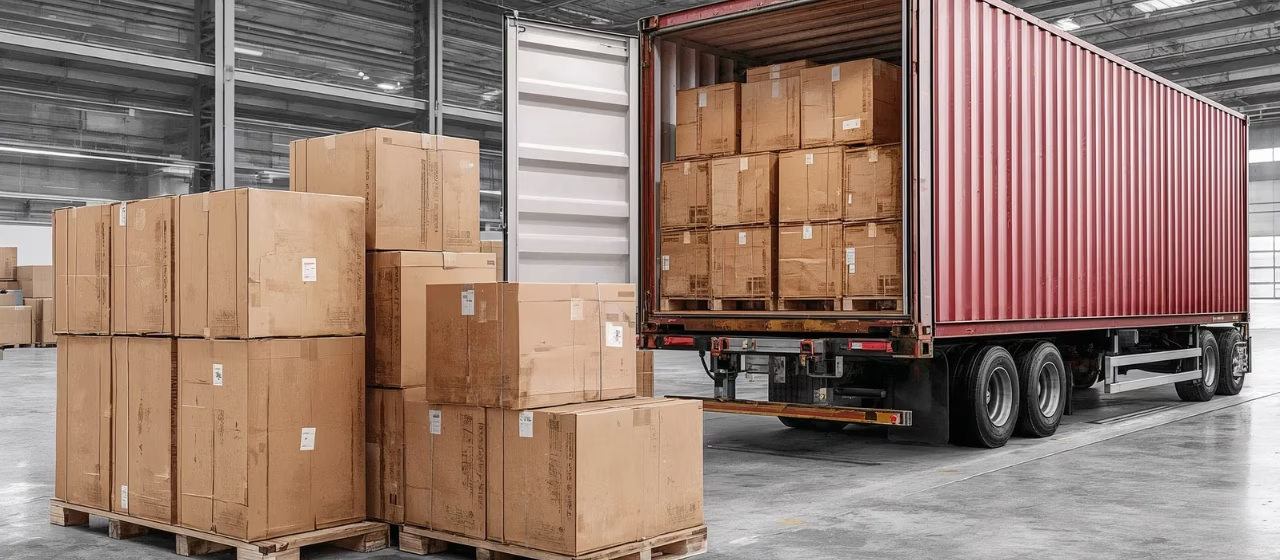
4PL logistics is a model in which a business outsources the management and coordination of its logistics operations to an external partner within an agreed scope.
For B2B and B2C businesses working with multiple warehouses or carriers, this approach helps coordinate operations more effectively. It also requires clearly defined responsibilities and information-sharing practices.
How does 4PL logistics work? How does it differ from 1PL, 2PL, and 3PL? Explore its benefits, challenges, and the steps involved in putting it into practice.
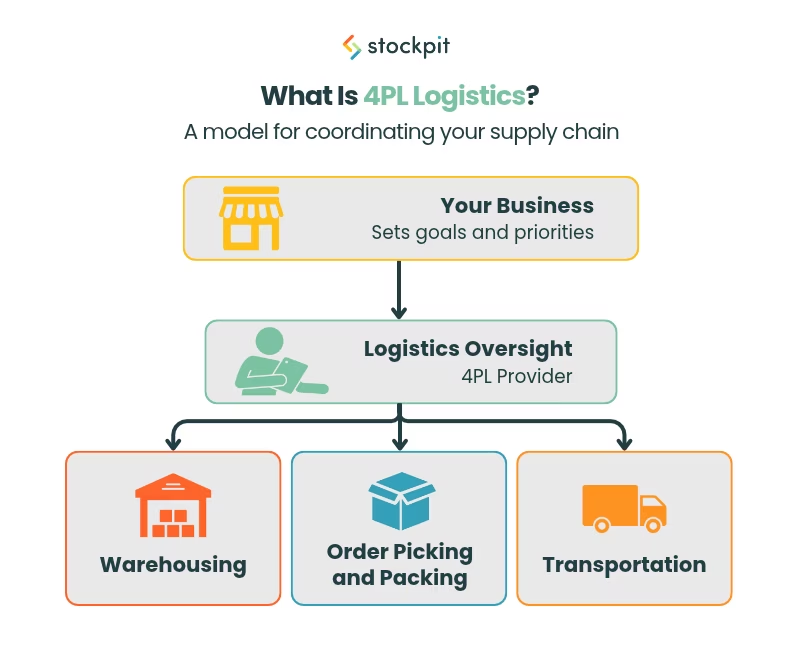
4PL, short for fourth-party logistics, involves outsourcing the management and coordination of logistics activities across an agreed scope. The 4PL provider coordinates the companies responsible for transportation, warehousing, and order fulfillment.
A business may already use an outsourced warehouse and several carriers. Without a 4PL model, its internal teams must coordinate these providers, share information, and monitor results. Under a 4PL model, a partner with visibility across the operation takes on that responsibility.
Outsourcing therefore extends to managing how operations and providers work together, beyond the physical tasks of transporting or storing goods.
Implementation starts with a review of the existing operation. Where are goods stored? Which providers are involved? What delivery deadlines must be met? This review helps define the scope of coordination and an approach that fits the business’s needs.
The model then relies on a clear division of responsibilities. Carriers, warehouse operators, and fulfillment providers generally handle the physical operations. The 4PL provider uses their resources and data to coordinate the overall process.
Depending on its contract, the provider may also select logistics partners, organize the movement of goods between locations, track shipments, and analyze performance. It also steps in when an issue requires a coordinated response, such as finding a solution after a delivery delay.
The business sets its priorities, approves objectives, and determines which decisions its 4PL partner can make without prior approval. The contract should spell out responsibilities and service commitments.
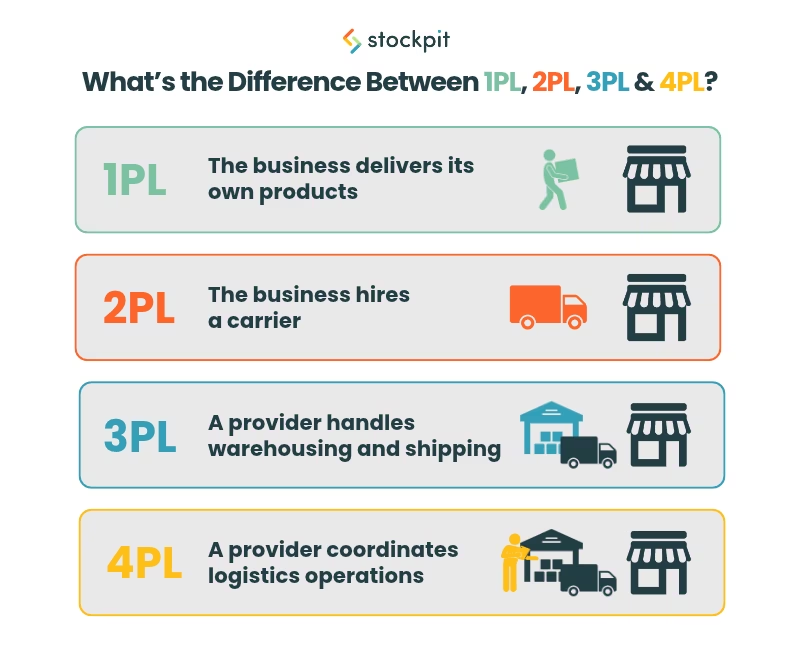
These models describe different levels of logistics outsourcing. To understand the differences, consider which operations are assigned to external providers and who is responsible for coordinating them.
Under a 1PL model, the business uses its own resources to store and transport goods. It manages its teams and oversees operations directly.
For example, a company that manufactures products, stores them in its own warehouse, and delivers them to customers using its own vehicles follows this model. It maintains control over its operation while funding the equipment and managing available capacity.
Under a 2PL model, the business hires a provider for a defined, asset-based service, such as transportation or warehousing. It retains responsibility for coordinating its logistics.
The business might prepare customer orders in its warehouse, then hand them over to a carrier for delivery. The carrier completes the agreed delivery. Storage, order preparation, and communication with other providers remain the business’s responsibility.
The 3PL model, short for third-party logistics, involves outsourcing several logistics operations to a provider. Its services may include receiving goods, warehousing, picking and packing orders, shipping, and handling returns.
The business sends its products to an outsourced warehouse. The 3PL provider receives them, prepares orders, and arranges shipping with carriers.
The business generally retains overall responsibility for managing its supply chain, particularly when it works with several 3PL providers.
Under a 4PL model, the business also outsources coordination across a broader scope. This model can bring multiple 3PL providers, carriers, and warehouse locations under centralized management.
If a business uses several warehouses to serve different markets, it may adopt a 4PL model to coordinate their activities and those of its carriers. The partner then monitors performance and looks for improvements across the network.
The main difference between 3PL and 4PL lies in the breadth of responsibility assigned to the provider. A 3PL partnership covers a set of logistics operations. A 4PL partnership also includes managing how those operations connect across multiple partners, based on the structure agreed upon with the business.
When several providers are involved, a late delivery can trigger a string of phone calls. The warehouse is waiting for confirmation, the carrier is looking for a document, and the sales team needs a reliable delivery date.
Under a 4PL model, communication between partners is centralized through a single point of contact responsible for coordination. That contact works with the relevant providers to resolve the issue. Internal teams spend less time following up with each provider individually.
Monitoring operations together helps identify underused capacity and steps that slow the movement of goods. With this broader view, the 4PL provider can improve transportation or warehousing arrangements.
B2B and B2C sales come with different requirements. Pallet orders run alongside individual shipments and customer returns. When these operations involve multiple partners, coordination becomes more demanding.
For example, a kitchen accessories business sells wholesale to retail stores and directly to consumers online. Before the holidays, orders increase across both channels. The business needs to meet the delivery dates promised to its retail customers while keeping shipments to individual consumers on schedule.
Assigning more responsibility to a partner creates dependency. Before signing a contract, establish how you will access your data and transition to another arrangement if needed.
Getting started also takes time and money. Systems need to be connected, data standardized, and teams trained. Ask how logistics partners are selected and how any business relationships the 4PL provider has with them are taken into account.
Coordination also depends on the quality of the information available. Incorrect quantities or delays in recording received goods make decisions harder. Check how inventory movements are recorded, information is shared, and discrepancies are resolved.
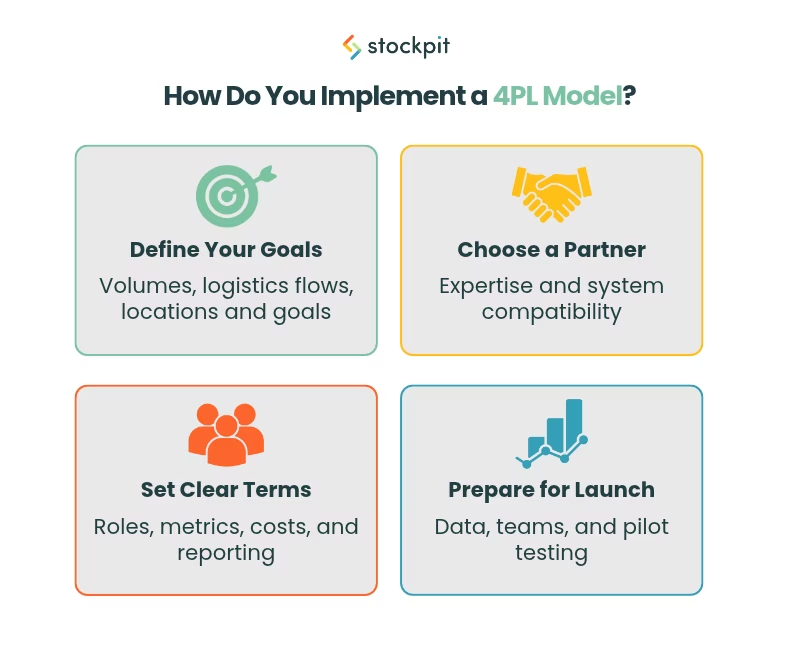
Describe your volumes, markets, product requirements, and delivery requirements. Identify the locations, movement of goods, and partners that require coordinated management.
Review recent incidents and the time spent resolving them. This list will help you set specific expectations and determine which responsibilities you want to assign to a 4PL partner.
Compare providers based on their ability to coordinate the operations within your defined scope. Ask how they manage communication, monitor performance, and handle incidents.
Also check whether their systems are compatible with those used by your business and existing partners.
Define who makes decisions, who takes action, and who keeps you informed when a problem occurs. Specify which decisions require your approval and which the provider can make independently.
Choose a few relevant metrics, such as on-time delivery, service level, order accuracy, logistics cost per order, and dispute resolution time.
Review additional fees, data access terms, and exit arrangements as well.
List the information that needs to be exchanged, how often it should be updated, and each party’s responsibilities. Allow enough time to connect systems and train teams.
Where practical, start with a limited scope and define success criteria before expanding.
The 4PL model serves businesses whose logistics operations require broader coordination. Its value should be assessed through costs, service quality, and time saved. Successful implementation depends on a defined scope, clear responsibilities, and measurable results.
Whatever approach you choose, inventory visibility remains necessary to understand what is available and what needs to be ordered.
Stockpit supports this process by tracking incoming and outgoing inventory, managing multiple storage locations, and creating purchase orders. Reorder points help you plan replenishment, while inventory valuation shows how much money is tied up in goods.
Before changing your logistics setup, make sure you have a clear view of your inventory. Discover Stockpit to track your goods and manage day-to-day purchasing.
Say goodbye to stockouts! Get your inventory valuation, monitor the inflow and outflow of products and keep track of your inventory.


